Friday, December 21, 2007

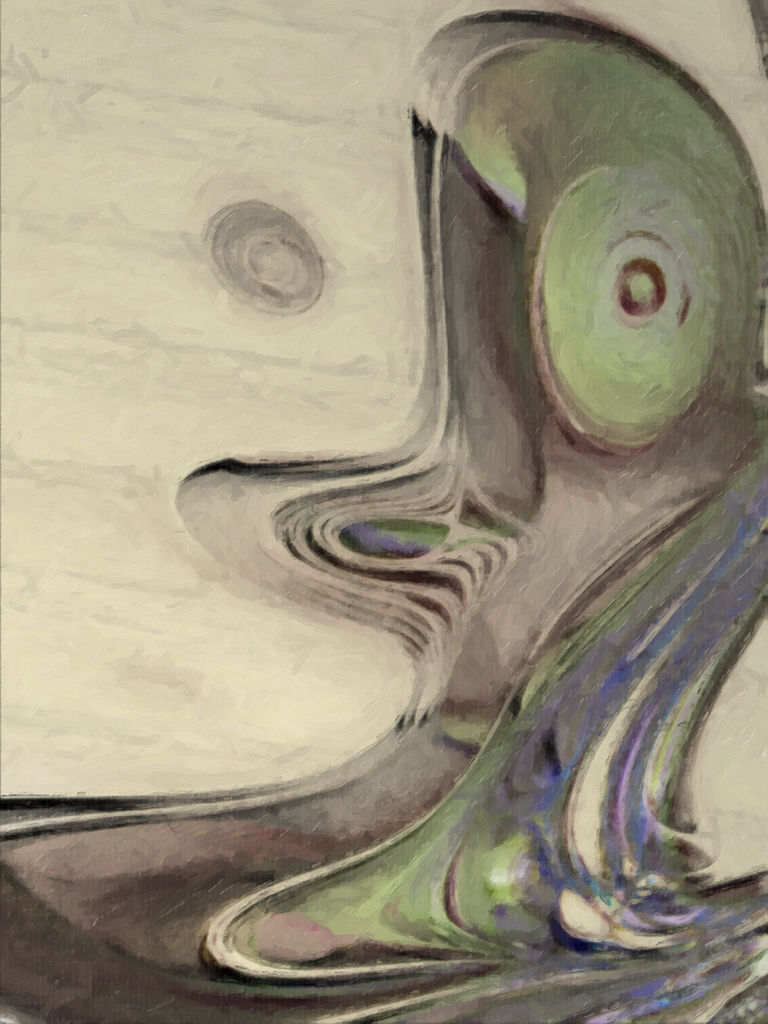
Swirl Cone

Swirl Cone

Swirl Cone (2003)

Inert gas blanketing during melting in holding furnaces. The melt surface is blanketed with argon or nitrogen in order to keep oxygen away from the melt surface, using either a patented vortex sprayer or swirl cone. This reduces gas pick up and oxide formation.
--Technological product offerring describing molten-metal blanketing from Air Products

Mmmm. Tasty.

~/~

Image made with QuaSZ and post-processed until dripping and melting became a serious obstacle.

Technorati Tags: , , , , , ,

Thursday, December 20, 2007

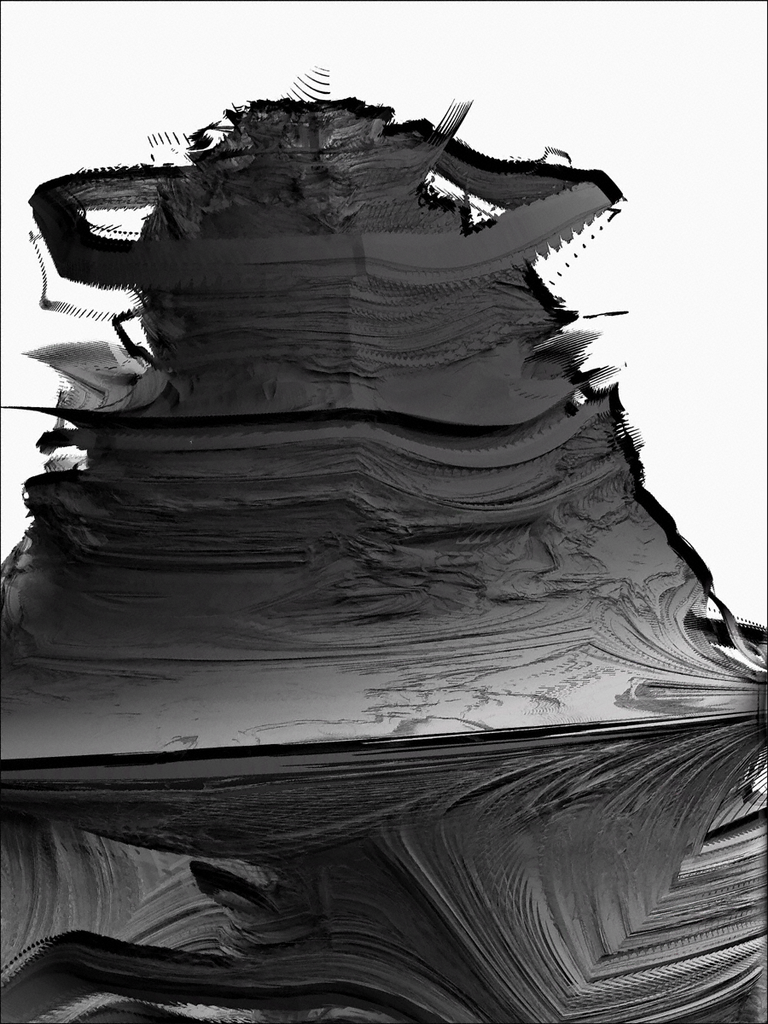
Warhead Waiting Game

Warhead Waiting Game

Warhead Waiting Game (2007)

A poet can write about a man slaying a dragon, but not about a man pushing a button that releases a bomb.
--W. H. Auden

~/~

Made with QuaSZ and post-processed somewhere between nuclear flash and thermal pulse.

Technorati tags: , , , , , ,

Wednesday, December 19, 2007

Termites

Termites

Termites (2007)

Termites are morphologically uncomplicated insects, in contrast with their astonishingly complex social behavior.
--Robert L. Smith, Termites

Several weeks ago, while commuting to work, I was listening to Dana Gioia, director of the National Endowment of the Arts, chatter away on National Public Radio about how no one reads anymore. He claimed that the majority of Americans had not read a single book (including technical manuals) in 2006. Apparently, other amusements have replaced a good read -- films, video games, and (probably) making digital art.

Which is too bad. Reading is a wonderful way to gain insights into the world -- or even into something smaller -- like the (assuming it exists) fractal community.

Last weekend, I found myself reading a collection of essays called Cyberspace Textuality: Computer Technology and Literary Theory (edited by Marie-Laure Ryan). One essay in particular stood out: "Virtual Termites" by Lance Olson. Olson was talking about the influences that led author William Gibson to pen his groundbreaking cyberpunk novel Neuromancer. According to Olson, one of the primary influences on Gibson was an essay by iconoclastic film critic Manny Farber called "White Elephant Art and Termite Art" (later compiled in Farber's book, Negative Space, 1974). Olson summarizes Farber's argument as follows:

Farber distinguishes between two kinds of art. The first, for which he holds contempt, is White Elephant Art, the sort that embraces the idea of a well-crafted, logical arena, incarnated in the films of Francois Truffaut. Proponents of this near-school produce tedious pieces reminiscent of Rube Goldberg's perpetual-motion machines that exude a sense of their own weight, structure, and status as masterworks. The second kind of art, which Farber advocates, is Termite Art. This is the sort that stands opposed to elite aesthetic culture, embraces freedom and multiplicity, is incarnated in the films of Laurel and Hardy. Proponents of this near-school produce pieces that gnaw away at their own boundaries, leaving little in their wake except traces of enthusiastic, assiduous, and messy endeavor.

See any parallels to Fractaldom?

I would argue that White Elephant Art can easily be seen in the Fractal Universe calendar selections and the overall UFractalus "school" that dominated the exhibition selectees of the first two Benoit Mandelbrot Fractal Art Contests. After all, are not these two entities the most public displays of the aesthetics of contemporary fractal art? Are these competitions not spun to the masses as the best fractal artists currently have to offer? Run the verbal footage from the 2006 BMFAC page:

It will exhibit high quality works by the most important fractal artists in the world [emphasis mine].

There's your ruling cultural aesthetic -- spelled out clearly and definitively. A pastiche of self-selected, self-proclaimed masterworks by our community's White Elephants.

The Rube Goldberg analogy fits, too. UFractalus school images are more built than made. Raid the parameter file repository and start stacking and connecting the elaborate pixellated parts. 100 layers. No post-processing. Better yet -- sign up for UF courses so you too can duplicate the reigning, assembly-line, "correct" fractal forms.

Or don't. Just make your own art. Explore the road not taken. Use programs other than Ultra Fractal. Post-process with wild abandon until you discover something you made and you like. Let accidents happen and embrace them for their surprises and suggestions -- like Laurel knocking Hardy on the head with a 2x4. In their films, the accidents make the meaning -- not the construction of the plot.

Gnaw away at the calendar swirls and the pre-fab UF look. As Farber observes:

Termite Art has no goal except to chew through its own limits, fuse and confuse, create zones where "culture" can't be located precisely, and where the artist can be cantankerous, extravagant, pushing creative possibilities and not caring what the results might be. It just keeps gnawing outward.

Keep gnawing until the foundation that houses the school of "the most important fractal artists in the world" begins to buckle. Then, just maybe, the prevailing aesthetic of fractal art will cherish personal vision and idiosyncrasy, value vitality over methodology, and be unselfconscious of its origins as either a "program" or a "style."

~/~

Originally posted at Orbit Trap.

Image made with Fractal ViZion and post-processed until the Orkin Man arrived.

Technorati Tags: , , , , , , , , , , ,

Tuesday, December 18, 2007

Pass the Angora

Pass the Angora

Pass the Angora (2000)

Ed Wood: Don't you think angora has a certain tactile sensuality lacking in all other fabrics?
Kathy O'Hara: Well, I suppose so. It is awfully expensive.
Ed: Well, it's made from specially-bred rabbits that live in the Himalayas.
Kathy: Say, what are you -- an angora wholesaler?
--Ed Wood

~/~

Technorati Tags: , , , , , , ,

Monday, December 17, 2007

Faust

Faust

Faust (2000)

E’en hell hath its peculiar laws.
--Goethe, Faust -- Part One

~/~

Enjoy the view. Going into photoblog mode for awhile.

Technorati Tags: , , , , , ,

Wednesday, December 12, 2007

Blue Mood

Blue Mood

Blue Mood (2000)

And why not? Tis the season.

Apparently, I'm not the only one...

~/~

Image made with Sterling-ware and post-processed until it went into a blue funk.

Technorati Tags: , , , , , ,

Tuesday, December 11, 2007

Frog Prince

Frog Prince

Frog Prince (2007)

George Walker Bush's story is that of a jester prince who always had his Poppy there to wipe up the frog guts from the pavement.
--miah, from Scientia Est Potentia

If our non-elected prince turned back into a frog:


~/~

From the ASK ME ABOUT MY GOVERNOR files:

I quit blogging about politics some time ago -- and nearly quit blogging completely.

Why bother? Since the 2006 election -- the so-called Democratic victory -- little has changed. The War of Lies Inc. drags on without an end in sight. The Dems seem content to suck their thumbs and give sub-30% approved Bush whatever he wants. Nothing changed. I went back quietly to my art.

But now, to my astonishment, my former governor, Mike Huckabee, long known in these here parts as "The Huckster," is apparently being taken seriously on the national stage and could well be my next president. And just when I was celebrating finally being rid of him after a long eleven nightmare years in Arkansas.

If you liked Bush, you'll adore The Huckster. You better. Otherwise, be prepared for a close encounter his thin-skinned, petulant churlishness.

The Huckster has a huge chip on his shoulder. Enough is never enough.

Tie down the silverware, too. The Rev-Bro-Gov will turn the White House into his private rectory.

You say you wanna theocracy? You always knew Bush was putting you on with all that Christian pandering to the base. Just a Rovian ploy. Not our boy Mike. He's a true believer in the whole literal Biblical, non-evolutionary, Adam and Steve, don't be Left Behind scenario. And The Rapture is only a red button press away.

And forget about gay rights (you'll probably be "isolated" anyway) and abortion rights (it's a holocaust, you see). Expect no compassion from this compassionate conservative -- unless you're a rapist the Clinton-haters hate. Preacher Mike is quick to forgive when the Lord's work results in his own political expediency.

I shudder when I contemplate hard drive crushin' Huckabee Supreme Court appointments. Bush will look enlightened by comparison.

But Huck's no bumbler like Bush. He's as slick and glib as they come. Quick with a joke, too -- usually at someone else's expense. Bad humor is his private rhetoric to avoid substance on any issue. You'll be laughing all the way to Armageddon.

But, unlike The Huckster, your one-way ticket into heavenly glory hasn't been pre-punched.

Long time Little Rock writer John Brummet has Our Former Governor pegged:

The Dumond matter raises worthy questions about Huckabee's ability or willingness to think beyond what his moral and partisan instincts tell him. The tobacco issue raises equally worthy questions about the chip on his shoulder and a rationalized sense of entitlement.

Dig into The Huffington Post's ongoing expose of Huckabee's pardon of Wayne Dumond -- first here, then here.

Max Brantley at the Arkansas Times has long had Huckabee's number. Read his Salon article here.

Mother Jones has a fairly good listing of quotable Hucksterisms here.

Unfortunately, writer David Corn leaves out some of my all-time favorites. Like Huckabee's signature on a document proclaiming women's role as a servant to men.

Who hearts Huckabee? Certainly not me.

Wake me when his MSM lovefest is over...

~/~

Technorati Tags: , , , , ,

Saturday, December 01, 2007

Summer in Malibu

Summer in Malibu

Summer in Malibu (1999)

Nine campers view photos
of longboarders and swells of smoke.
Hot Hub said industry crosstalk.
Click the link to flame on and off

premises. Dry weather, a tourist,
checks in and tan lines glow
white hot. Wet suits curdle. Surfers
crawl a foam floor nosing

wipe out exits. The coast highway
burbles plastic, cut by lasers.
Santa Ana blew back in from Texas
till stars flared on hillsides.

~/~

Hot Property

Firefighters fighting the Malibu fire in Carbon Canyon, 2007

Photograph by Adam Housely

From "Let Malibu Burn: A Political History of the Fire Coast" by Mike Davis:

Fire in Malibu has a relentless, staccato rhythm. The rugged coastline is scourged by a large fire, on average, every two and a half years, and at least once a decade a blaze in the chaparral grows into a terrifying firestorm consuming hundreds of homes in an inexorable march across the mountains to the sea. In one week last month, 10 homes and 14,000 acres of brush went up in smoke.

[...]

From the very beginning, fire has defined Malibu in the American imagination. Sailing northward from San Pedro to Santa Barbara in 1835, Richard Henry Dana described (in Two Years Before the Mast) a vast blaze along the coast of Jose Tapia's Rancho Topanga Malibu Sequit. Despite (or, perhaps, because of) Spanish prohibition of the Chumash and Gabrielino Indians' practice of annual burning, mountain infernos repeatedly menaced the Malibu area throughout the 19th century. During the boom of the late 1880s, the entire ex-Tapia latifundium was sold at $10 per acre to the Boston Brahmin millionaire Frederick Rindge. In his memoirs, Rindge described his unceasing battles against squatters, rustlers and, above all, recurrent wildfire. The great fire of 1903, which raced from Calabasas to the sea in a few hours, incinerated Rindge's dream ranch in Malibu Canyon and forced him to move to Los Angeles, where he died in 1905.

[...]

While county crews were still racing to the scene, the implacably advancing fire ambushed its first victims at a ranch a few hundred yards downhill from the water tanks. Miscalculating the fire's velocity, residents Ron Mass and Duncan Gibbins foolishly attempted to defend their homes with a garden hose. They recognized their mistake almost immediately, but it was too late. Mass jumped into his Jeep, but the fire caught him before he could get out of the driveway. Hideously burned, he managed to stagger to the edge of Old Topanga, where firefighters saw him, his blistered arms "outstretched like a scarecrow." British screenwriter Gibbins, meanwhile, had dashed back to rescue his cat. He ran right into the fire's deadly thermal pulse. It charred 95 percent of his body. Paramedics later discovered him, barely conscious, in the ranch's swimming pool. "'I don't want to die,' he said over and over," recounted the Times. "Smoke poured from his mouth, and he talked in the terrible high-pitched squeal of a man with lungs scorched beyond repair." (Gibbins died later in the hospital, but Mass survived his third-degree burns.)

[...]

Malibu at dusk was a surreal borderland between carnival and catastrophe. Nonchalant crowds played video games on the pier while television news helicopters hovered overhead like noisy vultures and the Coast Guard cutter Conifer stood offshore, ready to evacuate residents. Beneath the flaming hills, the Pacific Coast Highway was paralyzed by a hopeless tangle of arriving fire trucks and fleeing Bentleys, Porsches and Jeep Cherokees. Hundreds more locals trekked out on horseback, by bike or on foot. A few escaped on skates. Three hundred Sheriff's deputies were brought in to guard against looting. The chaotic exodus was oddly equalizing: panicky movie stars mingled with frantic commoners. Confronted once again with its a destiny as a fire coast, Malibu replied in the vernacular. "This is hell, dude," one resident told the Times. "I'm expecting to see Satan come out any time now."

Although today's featured image was made in 1999, the firestorm cycle returned in 2003 and again just last month to wash through Malibu's hills and canyons like a brimstone heavy.

There is nothing wrong with making beautiful fractals -- or engaging in art for art's sake. But like all good art, fractals can and should travel other roads not taken -- political-social-cultural expression, mirrors to nature, and humor (including sarcasm and irony).

Or historical documentation -- which, at least for today, burns the most fiercely.

~/~

Original poem, 2007. Image originally made in Sterling-ware and post-processed until blowback produced a blue screen of death.

Technorati Tags: , , , , , , , ,

Sunday, November 18, 2007

The Price of Professionalism

Naysayer

Naysayer (2007)

The price of professionalism is no more costly than the mistakes of amateurs.
--Slogan for MonkeyIT

The fractal contest fracases refuse to “go gentle into that good night.”

After much sound and fury (signifying nothing?) in the OT [Orbit Trap] comments, I finally posed this challenge seeking whether someone could:

explain to me why these contests make good ethical and professional models that reflect well on the fractal community…

To her credit, artist WelshWench made the attempt. I’d like to take the opportunity to address some of her points because they just might shed a bit more light on the problematic nature of both the Benoit Mandelbrot Fractal Art Contest and the Fractal Universe calendar competition. It is my hope that elaboration here will help to further clarify why both Tim and I have openly expressed concerns about how these competitions are being administered.

But first, I’d like to thank WelshWench for keeping her remarks civil -- a trait lacking in some of our critics.

WelshWench says:

I disagree that there is a conflict of interests when rules and conditions are clearly set out. No one who entered a fractal image for either the Calender or the BMFAC who had basic comprehension skills could have been under any misunderstanding whatsoever.

I disagree that they are conducted in an "unethical" manner for the same reason.

I have never argued the rules were not made public or were deceptive in any way. Instead, I have tried to point out that disclosure does not automatically make rules fair or ethical. Whether contestants agree to submission requirements also has no bearing on their justness. You seem to be arguing that contest organizers can set their own standards for propriety as long as they make a public, transparent disclosure of their intentions. Here are a couple of results from such open books: 40.3% of the images selected for the Fractal Universe calendars from 2005-2008 came from just four people -- the two current editors and the two previous editors. This year, the BMFAC “rules” allowed the judges to claim 40% of the exhibition space. If, next year, the “rules” set out that BMFAC’s judges will claim 90% of the available walls, will you still have no problem with the rightness of such stipulations?

Basically, we have asked questions about these contests in two areas: professionalism and conflicts of interest. Conflicts of interest occur when judges have personal interests that give them motives for accepting or rejecting entries for reasons other than perceived artistic merits. Wikipedia notes the following:

A conflict of interest exists even if no unethical or improper act results from it. A conflict of interest can create an appearance of impropriety that can undermine confidence in the person, profession, or court system.

Conflicts of interests in art competitions are acknowledged and have been widely addressed. For example, the College Art Association established guidelines in their “Statement of Conflict of Interest.” According to that text, one situation that “may present a potential conflict of interest” is the following:

The juror has a personal relationship with the nominee. Personal relationships that may create a conflict of interest include: family member, domestic or professional partner, research collaborator, teacher/mentor, student, dissertation advisor/advisee.

We have noted before and documented that current or former students of at least one judge were selected for the BMFAC exhibition. We asked if any safeguards were in effect to guard against such conflicts of interest -- and have received no reply. Although WelshWench claims that the “rules and conditions have clearly been set out,” this is not true; neither competition specifies procedures for handling potential conflicts of interest, including personal relationships judges have with contestants.

We’ve also wondered about Ultra Fractal’s prominence in the BMFAC contest. The massive submission sizes could be seen as favoring UF over some other programs incapable of producing such large dimensions. Moreover, a high percentage of exhibited images have been made with UF -- and most of the judges work primarily with that particular program. So what’s the problem? Another “potential conflict of interest” mentioned by the CAA is:

The juror could benefit from the decision financially.

Several of the judges receive payment for teaching courses on the use of Ultra Fractal. Would they not thus potentially have a stake in its promotion -- more sales? more students? Again, what safeguards were in place to prevent any possibility of influence peddling? This is a legitimate question. After all, as we saw above, a conflict of interest can exist “even if no unethical or improper act results from it.” Several BMFAC winners admitted taking UF courses taught by a judge or judges.

One might further ask if there are other BMFAC ties to UF -- especially since Jones, the contest director, hosts both the BMFAC site and the Ultra Fractal site on the same server-- not to mention his personal galleries there, too. If nothing else, he likely benefits from considerable linked cross-traffic -- and some of those surfers will stumble into his print pricing page.

WelshWench says:

You have a valid point that most competitions/contests do not include the judges work. But then most contests/competitions which are completely open charge fees for entries and quite a few I have seen which are solely for digital works also require the artists to stump up the cost of printing and framing, which is not the case for either of these.

The fees charged in many cases are, I would suggest, not only to cover the cost of the actual exhibition venue and associated publicity but also used to compensate the judges for their time. I would also suggest that having a single piece of one's own work exhibited is minimal compensation for the time spent judging the submitted works.

Indeed, most contests in any of the fine arts do not include the work of judges. And why is that? I’d argue it’s because doing so instinctively raises wave-the-red-flag ethical questions and fuels concerns about an appropriate level of professionalism.

You’re right. Entry fees are common -- used to cover the costs of displaying work, of publicity, and of paying judges. But you’ve left off something -- something of critical importance for this discussion. Entry fees also commonly pay for screeners -- individuals hired to prune down the large bulk of initial contest entries into a smaller, more manageable group of finalists who are then chosen for awards by (in most cases) a single judge or (sometimes) by a modest panel of judges.

And this is the stage where both fractal competitions go wrong. Why? Because they have turned their screeners into judges. Then, to make matters worse, they compensate them by allowing inclusion of their work to be displayed beside those they have juried. The result? The contests become flooded (at a rate of about 40%) with the screeners-now-judges’ works at the expense of the contestants. And how does this look to the outside? At best -- it appears extremely unprofessional. At worst -- it looks openly and unmistakably rigged.

Now, if these screeners were merely paid for their work and had none of their art in either competition, would I be asking questions about possible improprieties? No. If the panel members of BMFAC had winnowed the entries and passed on finalists only to Professor Mandelbrot for judging -- and then included several fractals of his --would that process be acceptable? Yes. Even respectful -- as a gesture of courtesy to a judge -- one judge.

But 40% of the final product? In the case of the FU, which is a hybrid of a publishing venture mashed with a competition, the editors function as screeners, and then the bigwigs at the publishing house make the final call. Why not just pay the FU screeners strictly for their services -- and hire even more screeners as insurance against potential conflicts of interest? Even if one accepts WelshWench’s view that including a “single work” is “minimal compensation,” it’s worth noting that inclusion in FU also comes with a paycheck -- and editors can submit additional work of their own (beyond the one piece grandfathered in as "minimal" compensation) into the batch of “finalists” sent to the publishers. Obviously, it’s good to be a current or former editor at FU -- as seen by the astronomical acceptance rate for that diminutive group of four individuals.

BMFAC is worse because it’s grounded in being first and foremost a publicity package for the judges. It was set up to front an invitational exhibition (of Jones' buds) who then are given a blank check to mix their unjuried work with that of the judged-by-them "winners." Thus, the judges' art takes on a more prestigious glow as the distinction blurs between juried and self-selected pieces. WelshWench’s minimal compensation of one image per judge adds up quickly here -- especially since these judges aren’t content with just being shown in the same space as the innumerable web-based “prizewinners.” No, BMFAC judges insist upon the resume-packing (and probably more profitable in the long run) wallop of inclusion in the gallery exhibit. With a ratio of 10 judges to 15 “winners,” the judges swallow up almost half the walls -- and that’s before a single contest entry dribbles in. Talk about having your cake and eating it way beyond “minimal compensation.” The judges have front row, reserved seats that come with free backstage pass perks.

And, yes, it’s nice not to have shell out expenses to mat, frame, and ship a print to Spain -- but a price is still being paid by the artists. They are giving up some artistic control over how their art will be presented. Jones says the printing and framing done for BMFAC is of the highest quality, and I have no reason to doubt him. Still, I’d always prefer my prints to be done by my own professional printer -- who understands how to bring out the best in my work. I also prefer keeping control over what inks and papers and canvas and mats and glass and frames will be used when my work appears in public venues. You have to ask: will a free contest assure the same quality control as you would?

WelshWench says:

So here's a serious, if hypothetical, question for you: would you prefer to see very many fractal artists excluded from entering competitions because they couldn't afford the entry fee and/or the costs of printing and framing? What about a contest that attracted many times the number of final exhibits at $25 a pop? How much of a profit do the organisers have to make before that verges on unethical?

To answer your hypothetical question requires some context. Do I want to see fewer artists enter fractal contests because financial constraints leave artists unable to afford entry fees, framing fees, and shipping fees? Of course not. But compared to what? Compared to having contests where conflicts of interest are not fortified and judges get a back door bye allowing them to eat up nearly half the presentational space? Well, what’s the lesser of two evils? I’d rather have a fair but pricier contest than one blowing off professionalism and shrugging off improprieties. Free lunches usually come with some kind of consequences.

Would I like a fractal contest that price gouges artists in an attempt to blatantly line the organizer’s pockets? Absolutely not. Such competitions would be grossly unethical and should be vigorously condemned. If a fractal contest appears that conducts itself in such a fashion, I will be here on OT to speak out immediately against any such practices that border on extortion.

But there are no such fractal contests at the moment. There are only the two under discussion. Their practices are not hypothetical.

Besides, are these the only choices available -- favoritism vs. profiteering? How about a fractal contest run like most of the art contests you alluded to earlier? One that keeps the professional distance between judges and contestants, charges a reasonable entry fee to pay organizational and screening/judging expenses, outlines guidelines guarding against conflicts of interest, and keeps entry requirements expansive enough to include as many programs (and thus styles) as possible? Perhaps the fractal community needs a guild or an organization to draft some generally agreed upon guidelines. There is a precedent. The Graphic Artists Guild composed and adopted such a document back in 1980.

WelshWench says:

I think there's room for both sorts of contest. But from what I've seen, without the organisers of the Calendar competition and the BMFAC, there wouldn't be any purely fractal competitions, let alone ones that people could enter at no cost to themselves.

I think there are really only two categories of art competitions: those run with a high degree of professionalism and those run with a low degree of professionalism. Personally, I’d rather face the prospect of having no purely fractal art competitions than continuing on with the status quo unchanged.

Why? I think we are all paying a very high cost for how these two contests are being handled. Ask yourself: how does it look to those outside of our small fractal fish tank when our competitions are nearly half-filled with the work of judges rather than contestants? Do we want fractal art taken seriously by the larger art world? Then we better begin appearing to art outsiders like we are professionals who care deeply about ethics and standards. Doing so means adhering to established practices designed to safeguard the integrity of our competitions -- as well as being willing to make sacrifices other art professionals routinely endure to ensure competitions maintain integrity and evenhandedness. We should not be defending questionable practices as either business-as-usual or as better-than-nothing.

There’s always a price to pay for professionalism. I wonder if our community has evolved to the point where we are willing to pay it.

If not, then hunker down and get used to art establishment honchos viewing us as amateurs and hacks who seem all too willing to turn a blind eye to corruption and cronyism.

~/~

This post originally appeared on Orbit Trap.

Technorati Tags: , , , , , , , , , ,

Sunday, November 04, 2007

Damien, Inc.

A Crash Course in Reaganomics

A Crash Course in Reaganomics (2000)

The medium is the message...
--Marshall McLuhan, Understanding Media

Marshall McLuhan was concerned with the observation that we tend to focus on the obvious. In doing so, we largely miss the structural changes in our affairs that are introduced subtly, or over long periods of time. Whenever we create a new innovation -- be it an invention or a new idea -- many of its properties are fairly obvious to us. We generally know what it will nominally do, or at least what it is intended to do, and what it might replace. We often know what its advantages and disadvantages might be. But it is also often the case that, after a long period of time and experience with the new innovation, we look backward and realize that there were some effects of which we were entirely unaware at the outset. We sometimes call these effects "unintended consequences," although "unanticipated consequences" might be a more accurate description.
--Mark Federman, "What is the Meaning of The Medium is the Message?"

Now that the pixel dust surrounding our open criticism of the mechanics of the Benoit Mandelbrot Fractal Art Contest seems to have settled, it is worth examining the reactions we received here at Orbit Trap. For the most part, our observations were ignored -- at least in terms of refutation. At best, the few explanations we received took the form of providing historical background. We learned the ostensible rationale for allowing BMFAC judges to mix work with the judged (those plebian sponsors insisted on the terms). We got the deep background on how The Fractal Universe calendar competition was established way back when and designed from day one to allow editors to conveniently slip their own work into the final product. The history lessons were mildly entertaining -- but none of them addressed the critical ethical lapses and jaw-dropping conflicts of interests displayed by the two best-known fractal competitions.

And what was the primary reaction to the questions we raised here on OT? Attack. Besmirch. Insult.

The consistency of the responses reminded me of a post by political blogger Digby when she discussed what she called cognitive relativism. The context for her remarks was drawn from the recent flap when Rush Limbaugh called Iraq War critics with military backgrounds "phony soldiers." Digby noted:

The Republicans have so fetishized the troops that it causes severe cognitive dissonance (and a potential fracture with their base) for Rush to come right out and say what he wants to say, which is that veterans and soldiers who disagree with the president on the war are traitors. But it slips out in little ways: "staff puke" and "phony soldier" and his insistence that you can't be a good "Republican" (soldier) and be critical of the war.

[...]

It's all wrapped in the warped worldview I described above, in which the Democratic party is not just wrong, it's fundamentally illegitimate. And anyone who disagrees is a traitor, including, apparently, the vast majority of Americans who do not support this war.

Digby, of course, is alluding to the tendency of the American right-wing attack machine to question the patriotism of neocon critics. Worse, such critics deserve castigation as traitors for even daring to raise questions or to challenge status quo policies.

Tim and I began to notice similar reactions once we suggested that all was not quite right in Fractaldom. We were "cowards" who refused to "get over" the way things inherently had to be. We were "behaving irrationally" and "tempted to do something rash" (see the comments to this OT post) -- and our assertions were "ridiculous," "beyond absurd," and "utter poppycock." Some commenters demanded repeated apologies. It was clear we had to be "self-serving," boring," and "pedantic." In other words, if the messengers are stabbed often enough, then perhaps readers will forget what messages were delivered in the first place.

And, as Digby noted, there was a further sense that even raising such questions was fundamentally illegitimate. Damien M. Jones threw this in my face: "You're no prophet regurgitated from the belly of a fish, forced to deliver a message of impending doom." How dare I cast myself in a Moses role to bring down truth from the mountaintops -- by having the gall to be deranged enough to question Jones' actions and thus continue to "speak out of my ass"? And Keith MacKay, in a (now deleted) post thread on his newly established forum, explained his decision to ban me from his forum's blog was to insure I wouldn't keep on "pissing on the fractal community" -- as if raising questions about the appropriateness of how fractal contests are run somehow personally tarnishes every fractal artist. In short, Tim and I are "traitors" to the community for speaking up in the hope that people administering fractal competitions do so in a fair and ethical manner.

But, just as Rush Limbaugh can't wrap his mind around the fact that some Iraq veterans can be Democrats, OT's critics can't see that Tim and I are just as much a part of the fractal community as they are. Moreover, they seem unable to comprehend why we prefer a clean neighborhood to a dirty one.

~/~

There's something else on my mind lately.

It's one thing to suck up 40% of the wall space for an exhibition -- as the judges for this year's BMFAC did lately. But it's another thing to buy up 40% (or more?) of the web space used to present fractal art galleries, software, and contests.

And, yet, that is exactly what Damien M. Jones has done.

You have to give him high marks for cleverness. If you build your own server, they will come. And come they did. To join his in-house web ring -- the Infinite Fractal Loop. To nestle their web pages on his private fractal clearinghouse -- Fractalus. To download his personally championed software -- Ultra Fractal. To enter his contests and read his Fractal FAQs and join his mailing lists. Welcome, one and all, to Damien, Inc.

And what does Jones reap for all of this sowing -- besides bandwidth expenses? Who knows if he gets a cut of the UF profit pie? And who cares? Not me. I'm not against artists or programmers making money for their creative efforts. But still I wonder. Is Jones truly a saintly, altruistic patron of the fractal arts?

Certainly, he gets some benefits from underwriting a controlled environment to his own liking. Hits aplenty come to his site(s) -- and, eventually, make their way to his personal gallery, his aptly named Egosite, his personal rants, or his account of conversion to Christianity. Just as the BMFAC contests make sure the judges have their space first, there's no shortage of Jones to be found on the "collective" that is Fractalus. Even though Jones uses the plural "we" to describe the mission of Fractalus, the site definitely starts with and centers on him.

And that's why Jones' empire reminds me of Reaganomics. It focuses on what George W. Bush once called "the have-mores" -- like the privileged few who are hosted by Fractalus -- or the FODs (Friends of Damien) who double as BMFAC judges -- or the Olympians invited into the BailOuts, a private, invitation-only UF fractal list/club. The rest is all trickle down. You serfs might get dribbled an Honorable Mention in the latest contest -- but only as a tossed bone to ensure the judges have a permanent place-setting at the annual exhibit table. Or, here, have a crumb -- a small spot in the IFL ring -- a corner nook to park your blog.

Yes, Jones once offered to house Orbit Trap on Fractalus. Tim and I thanked him, but said no. Why?

I guess we fretted over those "unanticipated consequences" Federman mentioned earlier. As McLuhan notes, he who controls the medium controls the message. If you're snugly nuzzled in somewhere under Jones' web blanket, don't get too comfortable. Don't question the natural order. Don't bite the hand that feeds you. It's his house, kids. And his rules.

And what happens if you cross him and his? I know.

You're thrown out into the street -- because what you see as free expression can be twisted and labeled as irrationality. And once you've abandoned reason, aren't you thus more prone to rash behaviors-- like having the nerve to presume to disagree with Jones? You'll surely be called a "security risk" -- after the fact, of course -- and must be given the boot to protect the safety of the good squatters who politely keep mum on Jones' server. Never mind that you're hardly a genius kid hacker huffing down Cheetos in a basement in the Philippines and wouldn't know the first thing about cracking ice (hey, I read Neuromancer) to pillage folders. Never mind that most of this blog's readers know that Fractalus has to be one of the most buttoned-down, secure servers on this planet. Such charges must be laughable. Such actions by Jones will be obviously punitive. But with plenty of obfuscation, maybe people will be gullible enough to believe you were ousted because you posed a threat.

But it's not a server that's threatened. It's Jones' empire itself.

So to anyone homesteading in Jones' kingdom, just bear in mind it's a feudal system -- and there's a price to pay your lord for that free lunch. Don't rock the fractal community cruise ship kitchen by openly preparing unpleasant or noisome opinions. And, always, keep any adverse thoughts turned down to a simmer.

Otherwise, that fractal trickle will likely become a drip evaporating in dry air.

And, then, once that happens, as Baudrillard claims and Morpheus of The Matrix observes: Welcome to the desert of the real.

~/~

Originally posted on Orbit Trap.

Technorati Tags: , , , , , , , , ,