
The Lost Art of Listening (1999)
You seem uninterested. I probably need to focus. Better get to the point. Ask me a question. Can you read my non-verbals?

The Lost Art of Listening (1999)
You seem uninterested. I probably need to focus. Better get to the point. Ask me a question. Can you read my non-verbals?
Crab Disco (2006)
For yourself, sir, shall grow old as I am, if like a crab you could go backward.
--William Shakespeare, Hamlet
Something new for you to raise one pincher high and shake your crustacean booty...
Neptune Probe (1998)

Ganymede Probe (1998)
These heavenly bodies are still in good standing after astronomers recently convened to decide who would be voted off the cosmic island.
Everyone held its slot in space, and even Xena kicked some Van Allen Butt Belt -- everyone except poor elliptical Pluto. Alas, we hardly knew ye. From National Geographic:
The distant, ice-covered world is no longer a true planet, according to a new definition of the term voted on by scientists today [8-24-06].
"Whoa! Pluto's dead," said astronomer Mike Brown, of the California Institute of Technology in Pasadena, as he watched a Webcast of the vote. "There are finally, officially, eight planets in the solar system."
In a move that's already generating controversy and will force textbooks to be rewritten, Pluto will now be dubbed a dwarf planet.
But it's no longer part of an exclusive club, since there are more than 40 of these dwarfs, including the large asteroid Ceres and 2003 UB313, nicknamed Xena -- a distant object slightly larger than Pluto discovered by Brown last year.
[...]
Pluto has been demoted because it does not dominate its neighborhood. Charon, its large "moon," is only about half the size of Pluto, while all the true planets are far larger than their moons.
In addition, bodies that dominate their neighborhoods, "sweep up" asteroids, comets, and other debris, clearing a path along their orbits. By contrast, Pluto's orbit is somewhat untidy.
Yeah. Nothing's worse than an untidy wannabe planet. Somebody get an industrial Dustbuster and sweep this galactic imposter under the heliosheath.
But more than science textbooks will have to be recalled faster than those spontaneous combustion laptop batteries. Popular culture itself will need to be reconstituted. Consider this tragic case:

Disneyologists argue that the Gang already includes a male dog, Goofy, who, like the other members, can walk and talk. Including a non-speaking quadrupedal character like Pluto would necessitate the inclusion of other insufficiently anthropomorphized animals such as background cats, birds, and humorous bees.
[Image seen on Jetting Through Life. Text from Tom the Dancing Bug by Ruben Bolling.]
Pluto's downsizing will likely leave some astronomers scurrying to pawn their telescopes as their employment orbit decays faster than Hubble's. One victim will be 93-year-old Patricia Tombaugh, widow of Clyde Tombaugh, Pluto's discoverer. Her reaction, according to MSNBC's Cosmic Log:
"I don't know just how you handle it. It kind of sounds like I just lost my job," she told AP from Las Cruces, N.M. "But I understand science is not something that just sits there. It goes on. Clyde finally said before he died, 'It's there. Whatever it is. It is there.'"
There, huh. Now beat it. Half lights out, pal. We don't want any. Sign up your planetary has-been behind for the no-flyby no-call (us-we-call-you) list.
Meanwhile, in an Blog with a View exclusive, yr blogger -- through my unnamed source I'll call "Cosmic Dustball" -- was able to obtain this exclusive webcam footage of some Plutonian freedom fighters reacting to the news of their planet's solar system washout:

Mutiny on Pluto (2003)
We want to be a world and we want it now!!
After the Contraceptive Fails (2002)
Uh-oh. BushCo doesn't feel your pain. I guess you shouldn't have dropped that abstinence course -- especially if you're under eighteen.

The New Wetlands (2006)
From Bob Marshall in Field and Stream:
The Bush Administration announced last week that the nation is no longer losing wetlands -- as long as you consider golf course water hazards to be wetlands.
Really.
Thursday [March 30, 2004], Interior Secretary Gale Norton called a press conference to claim our long nightmare of wetlands loss had finally come to an end due to unprecedented gains since 1997. However, she then admitted much of that gain has been in artificially created ponds, such as golf course water hazards and farm impoundments.
The sporting community -- from Ducks Unlimited to the Theodore Roosevelt Conservation Partnership -- reacted quickly, and not favorably. Researchers long ago established that natural wetlands such as marshes, swamps and prairie potholes are far more productive than even the best-designed artificial wetlands. And sharp-edged water bodies like water hazards, farm ponds, and even reservoirs offer very little for wildlife. Putting man-made ponds in the same class as natural wetlands is like ranking pen-raised quail with wild coveys.
The boldness of Norton's claim was particularly galling given the Bush Administration's record on wetlands. President Bush, like other presidents before him, promised a policy of “no net loss” of wetlands, but his administration has consistently supported rollbacks of the Clean Water Act to satisfy industry and development.
In fact, at the same press conference, the Fish and Wildlife Service reported a continued loss of 523,500 acres of natural wetlands during the same time period. So how could the nation have come out ahead if it lost more than half a million acres? Norton didn't try to hide the truth: The 715,300-acre “gain” was mainly artificial ponds.
[...]
Norton's announcement was likely an act of setting the table for more administration assaults on wetlands protections. It was probably no coincidence that three days earlier, the Army Corps of Engineers and Environmental Protection Agency proposed new regulations that encourage development of companies that build artificial wetlands used by industries that destroy the vital natural habitats. It's part of the wetlands mitigation banking concept -- which gives companies permits to drain wetlands, as long as they produce “new” wetlands somewhere else.
Ah, yes. The new wetlands. Talk about your water hazards. In BushCoLand, the only ducks you'll see will be people dodging stray golf balls.
Now watch this dive drive...
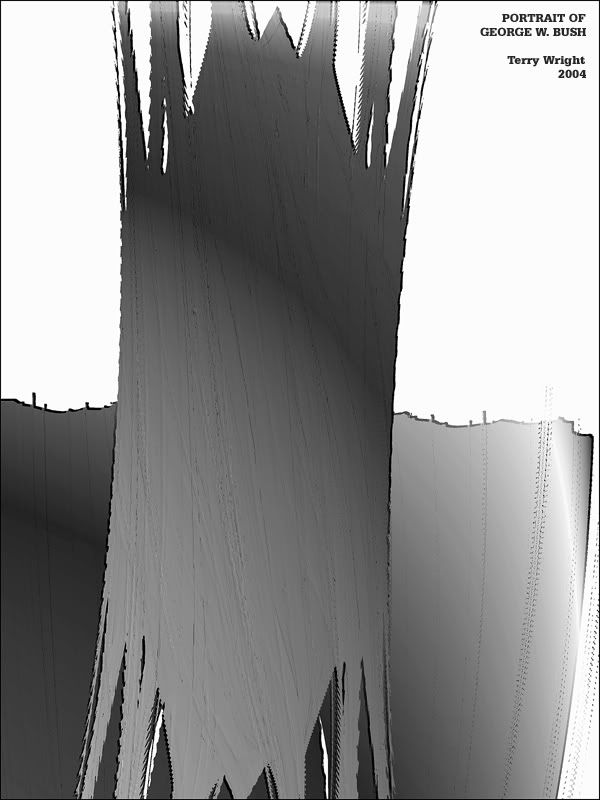
Portrait of George W. Bush (2004)
Writing poetry after Auschwitz is barbaric.
--Theodor Adorno
A poem that calls us from the other side of a situation of extremity cannot be judged by simplistic notions of "accuracy" or "truth to life." It will have to be judged, as Ludwig Wittgenstein said of confession, by its consequences, not by our ability to verify its truth. In fact, the poem might be our only evidence that an event has occurred: it exists for us as the sole trace of an occurrence.
--Carolyn Forche, "The Poetry of Witness"
Artists do not create in a vacuum; they are indisputably coupled to the society and times in which they work. It may well be that an artist can realize aesthetic triumphs while ignoring society, but willful unconcern regarding social matters is also a political position.
--Mark Vallen, "Why All Art Is Political"
The war, what was happening to America, the brutality of the world. What kind of man am I, sitting at home reading magazines, going into frustrated fury about everything -- and then going into my studio to adjust a red to a blue?
--Phillip Guston, Writing in the mid-1960s
The common wisdom is that people should not talk about two things. This is one of them.
I don't think your everyday entry-level fast food French fryer and one-day-in-the-future museum patron thinks much about the possibilities of incorporating political statements into fractal art. A fractal, to those blessed enough to recognize one, is likely more akin to eye candy -- saturated swirls seen on a calendar in Barnes and Noble. Or something vaguely tied to mathematics -- more like a theorem than a painting -- or a pretty picture intersecting with irrational numbers but never with social, economic, or political concerns. Fractals can be visually stunning -- but can they stun others into epiphanies -- or just say anything to anyone about his or her life? Should they be used to comment on world affairs, social concerns, or even popular culture?
There are some, both proletariat and bourgeoisie, and convinced that fractals have no grounding in the world, who would find such questions absurd. I remember a day last winter when I dropped by to pick up some Giclees from the photographer who handles prints for me. His wife, a painter, studied the fresh prints briefly before laughing. "Well, there's certainly nothing like this in nature," she said confidently. "Don't be so sure," I replied, pointing to one of the studio's windows. Outside, the bare branches of an oak tree were reaching skyward to obscure a bank of self-similar clouds.
A hypothesis then. If fractals are of this world, then they can also be utilized -- politically activated, as it were -- to comment upon what happens in it.

The Enron Board Meets for the Last Time (2002)
If one accepts the premise that fractals can be art -- and I do -- then all the historical/philosophical paradigms and puzzles about the nature of art apply to fractal art as well. Artists, fractal or otherwise, who dabble in and dab on politics to their renders walk some fine lines and climb some slippery slopes. Is one's art serving as a cry for social reform while still displaying elements of Keats' Siamese twins of truth and beauty -- still providing a gesture that calls the soul upward? Or does such art become reductive, didactic, polemical -- a blunt instrument to bludgeon the viewer into accepting the artist's point of view?
Dyske Suematsu, in "The Paradox of Political Art," leans to the latter position:
The most apparent problem I see with today’s political art is its deterministic nature. Art often raises salient questions, but when a political artwork is morally motivated, its questions become moral directives disguised as questions. That is, they are rhetorical questions. As such, there is a right way and a wrong way to look at it. A correct answer is always already provided for you by the artist. The questions and the discussions it provokes either support the answer or refute it. And, the value of the work is contingent on its dialectical outcome. From the point of view of the audience, the experience of such political art resembles that of reading an op-ed column in a newspaper.
Point well taken. Why are you reading Blog with a View? Presumably to see and read about fractal art, yes? If you wanted political discussion, you would have pointed your surfboard to Salon or Slate or Daily Kos or Little Green Footballs? Hippie jerk blogger. Bring on more spirals.
Maybe it is best to be careful before one gets all socially aware. Suematsu has other complaints with political artists. They assume a ethical superiority but are not required to show that their own expressions are ethically pure. After all, why did I do the piece above about Enron? Was it because I was outraged by the scandal and appalled that the company's employees were cheated out of their pensions? Or was it because I figured seizing a hot button political topic could help further my career as an artist? And if I lampoon Enron's directors, don't I have a reciprocal obligation to show that my motives are not just as crass?
And what form would such proof take? How can political artists demonstrate that their intentions are sincere? Testify before a Congressional committee? Undergo short-of-organ-failure questioning while being waterboarded at Guantanamo? Donate all the money made from their fractal art (haaaa!!!) to Feed the Children? Will such philanthropy in turn make my intentions for lashing out at Enron execs as selfless as those of Mother Teresa in your eyes?

Dream of Napalm (2006)
But can any artist or artwork completely wash its Pontius Pilate hands clean from the stink of politics. After all, George Orwell, in Why I Write, asserts that all art is political and notes: "The opinion that art should have nothing to do with politics is itself a political attitude." So, since art cannot be apolitical, should artists serve as "witnesses" for the times they live in -- especially if other information agencies (Fox News, cough cough) increasingly editorialize and are openly biased to particular political viewpoints. Should the studio, or the fractal generator, be an ostrich hole? Or does the artist have an obligation to record injustices and atrocities and document corruption and cultural insanity? If not the artist, who? Will governmental records accurately portray a regime or does such a historical record run a greater risk of being sanitized? Moreover, will any state-sanctioned archives be told more convincingly than the visual language art can speak? Take, for example, this:

A child's drawing of arriving at Terezin Concentration Camp where 15,000 children died.
[Image seen on Children's Art of the Holocaust]
Some artists sense the pull of history deeply and feel self-expression through art can be constructive towards spurring social change. Art Hazelwood, speaking earlier this year at a panel discussion on "Political Art -- Timely and Timeless" said:
Over the last several years I’ve talked to lots of people about political art and there has been a gradual shift. Before the Iraq War there seemed to be an attitude that political art was out of date or people had a general hostility towards it. But recently I’ve noticed a shift in people’s attitudes. People I have talked to are changing their minds. There are still the purists who believe that any concession will debase the temple of art, but their voice, once supreme in the art world, is now growing weaker. And it is obvious why. Political art might always have a place but in a time of war, and in a time of a rising police state political art becomes a necessity.
[...]
Some people say that political art has no effect in changing people’s minds, that it is preaching to the converted. To which I would answer...no one ever measured the value of a painting of the crucifixion by how many converts it made. Political art is cumulative in its effect. Its not merely one political print that changes the world. It is a part of a cultural movement.
Others, like Jed Perl writing in the New Republic, observe that art cannot always be expediently insulated from life.
The artists who find it difficult to turn from the horrors of the morning news to the specialized problems that confront them in their studios are confronting an authentic dilemma, for even ivory towers have doors and windows. While dropping the day's headlines into the middle of a canvas may never be a way of making a painting, an artist's far-flung experience must be allowed to seep into the studio, if only in a dialectical way -- as a tumult of feelings to which the orderly spirit of a still life or a geometric abstraction offers a much-needed riposte.
Legacy of Exxon (2000)
Am I wrong to show President Bush as a faceless blank slate -- as an empty vessel to be filled up with NeoCon nonsense by those shielding him in his no-bad-news bubble? Have I degraded my art or pummeled your temples because I suggest the Enron board is a pack of dogs and that Exxon's legacy is a horrific oil spill in Alaska. Maybe.
Not all of my art is political. I can (try to be) funny. I sometimes wander into nature. But some days the news of the world intrudes into my generator. Maybe I'm poisoning a percentage of my audience -- and foolish to hope for cultural awareness and progressive social change -- and admit that my ethics and morals could probably use a thorough questioning. But there is one thing I can say for certain about those days when politics creeps in to my fractals...
I sleep better on those nights.
~/~
Bush: Generated in QuaSZ. Minimally post-processed.
Enron: Generated in Fractal Zplot. Heavily post-processed.
Napalm: Generated in Sterling-ware. Heavily post-processed.
Exxon: Generated in Dofo-Zon Elite. Heavily post-processed.
~/~
Cross-posted to Orbit Trap


